Frequently Asked Questions
Fatal Python error: Bus error
This error message is due to a shm-size that is too small. Try updating your shm-size according to this guide.
How can I get sound or audio in my recordings?
By default, Frigate removes audio from recordings to reduce the likelihood of failing for invalid data. If you would like to include audio, you need to set a FFmpeg preset that supports audio:
ffmpeg:
  output_args:
    record: preset-record-generic-audio-aac
How can I get sound in live view?
Audio is only supported for live view when go2rtc is configured, see the live docs for more information.
I can't view recordings in the Web UI.
Ensure your cameras send h264 encoded video, or transcode them.
You can open chrome://media-internals/ in another tab and then try to playback, the media internals page will give information about why playback is failing.
What do I do if my cameras sub stream is not good enough?
Frigate generally recommends cameras with configurable sub streams. However, if your camera does not have a sub stream that is a suitable resolution, the main stream can be resized.
To do this efficiently the following setup is required:
- A GPU or iGPU must be available to do the scaling.
- ffmpeg presets for hwaccel must be used
- Set the desired detection resolution for
detect -> widthanddetect -> height.
When this is done correctly, the GPU will do the decoding and scaling which will result in a small increase in CPU usage but with better results.
How can I rotate my camera's video feed?
Rotation is best done in the camera's firmware settings (usually called rotate, flip, or corridor mode) so the video arrives already rotated and no extra processing is needed. Check there first.
If your camera does not support rotation, go2rtc's ffmpeg module can rotate the stream with the #rotate parameter (90, 180, 270, or -90), but this is not recommended: rotation requires transcoding (re-encoding) the video, which significantly increases CPU usage, especially for high resolution streams.
go2rtc:
  streams:
    my_camera: "ffmpeg:rtsp://user:password@192.168.1.10:554/stream#video=h264#hardware#rotate=90"
Point the camera's inputs at the restream as described in the restream docs, and swap detect -> width and detect -> height to match the rotated resolution.
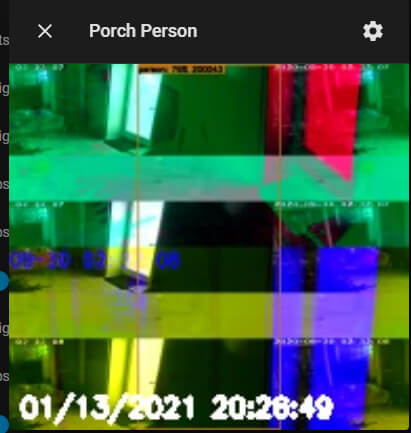
My mjpeg stream or snapshots look green and crazy
This almost always means that the width/height defined for your camera are not correct. Double check the resolution with VLC or another player. Also make sure you don't have the width and height values backwards.
"[mov,mp4,m4a,3gp,3g2,mj2 @ 0x5639eeb6e140] moov atom not found"
These messages in the logs are expected in certain situations. Frigate checks the integrity of the recordings before storing. Occasionally these cached files will be invalid and cleaned up automatically.
"MQTT connected" repeats in the logs
If you see repeated "MQTT connected" messages in your logs, check for another instance of Frigate. This happens when multiple Frigate containers are trying to connect to MQTT with the same client_id.
Error: Database Is Locked
SQLite does not work well on a network share, if the /media folder is mapped to a network share then this guide should be used to move the database to a location on the internal drive.
Unable to publish to MQTT: client is not connected
If MQTT isn't working in docker try using the IP of the device hosting the MQTT server instead of localhost, 127.0.0.1, or mosquitto.ix-mosquitto.svc.cluster.local.
This is because Frigate does not run in host mode so localhost points to the Frigate container and not the host device's network.
How do I know if my camera is offline
Frigate publishes a per-role health status to frigate/<camera_name>/status/<role>, where <role> is each enabled role on the camera (detect, record, and audio). The published value is one of:
online: Frigate's process for that role is running normallyoffline: the process is down and Frigate is restarting itdisabled: the camera is turned off, either at runtime or in the configuration file
These reflect the state of Frigate's process for that role, not the camera's reachability, so an unreachable camera alternates between offline and online as the watchdog restarts ffmpeg. Wait for the status to hold steady (for example with Home Assistant's for:) rather than acting on a single message.
Because the status is per role, a camera whose substream is fine but whose recording stream has dropped will report online for detect and offline for record. The status is republished whenever it changes.
You can also detect an offline camera through /api/stats, where camera_fps will be 0.
How can I view the Frigate log files without using the Web UI?
Frigate manages logs internally as well as outputs directly to Docker via standard output. To view these logs using the CLI, follow these steps:
- Open a terminal or command prompt on the host running your Frigate container.
- Type the following command and press Enter:
This command tells Docker to show you the logs from the Frigate container. Note: If you've given your Frigate container a different name, replace "frigate" in the command with your container's actual name. The "-f" option means the logs will continue to update in real-time as new entries are added. To stop viewing the logs, press
docker logs -f frigateCtrl+C. If you'd like to learn more about using Docker logs, including additional options and features, you can explore Docker's official documentation.
Alternatively, when you create the Frigate Docker container, you can bind a directory on the host to the mountpoint /dev/shm/logs to not only be able to persist the logs to disk, but also to be able to query them directly from the host using your favorite log parsing/query utility.
docker run -d \
  --name frigate \
  --restart=unless-stopped \
  --mount type=tmpfs,target=/tmp/cache,tmpfs-size=1000000000 \
  --device /dev/bus/usb:/dev/bus/usb \
  --device /dev/dri/renderD128 \
  --shm-size=64m \
  -v /path/to/your/storage:/media/frigate \
  -v /path/to/your/config:/config \
  -v /etc/localtime:/etc/localtime:ro \
  -v /path/to/local/log/dir:/dev/shm/logs \
  -e FRIGATE_RTSP_PASSWORD='password' \
  -p 5000:5000 \
  -p 8554:8554 \
  -p 8555:8555/tcp \
  -p 8555:8555/udp \
  ghcr.io/blakeblackshear/frigate:stable
My RTSP stream works fine in VLC, but it does not work when I put the same URL in my Frigate config. Is this a bug?
No. Frigate uses the TCP protocol to connect to your camera's RTSP URL. VLC automatically switches between UDP and TCP depending on network conditions and stream availability. So a stream that works in VLC but not in Frigate is likely due to VLC selecting UDP as the transfer protocol.
TCP ensures that all data packets arrive in the correct order. This is crucial for video recording, decoding, and stream processing, which is why Frigate enforces a TCP connection. UDP is faster but less reliable, as it does not guarantee packet delivery or order, and VLC does not have the same requirements as Frigate.
You can still configure Frigate to use UDP by using ffmpeg input args or the preset preset-rtsp-udp. See the ffmpeg presets documentation.
Frigate is slow to start up with a "probing detect stream" message in the logs
When detect.width and detect.height are not set, Frigate probes each camera's detect stream on startup (and when saving the config) to auto-detect its resolution. For RTSP streams Frigate probes with ffprobe and automatically retries over TCP if UDP doesn't respond, with a 5 second timeout per attempt. A camera that cannot be reached over either transport will add up to ~10 seconds to startup before Frigate falls through with default dimensions, which may show up as width 0 and height 0 in Camera Probe Info under System Metrics.
To skip the probe entirely and make startup instant, set detect.width and detect.height explicitly in your camera config:
cameras:
  my_camera:
    detect:
      width: 1280
      height: 720
What is the version key in my config file?
version records the config format that your config was last migrated to. On startup Frigate compares it against the format the running version expects, and if it is older it copies your config to /config/backup_config.yaml, rewrites it to the new format, and updates version as the final step. A config with no version key is assumed to predate 0.14 and is migrated from there.
Frigate manages this key for you, so do not set or edit it. Raising it makes Frigate skip migrations your config still needs, and lowering it re-runs migrations against config that has already been converted. Either can leave you with a config that no longer validates.
Why does Frigate keep creating new tracked objects for my parked car?
Stationary tracking is designed to prevent this: a parked car should remain a single tracked object rather than generating new ones. If you're repeatedly getting new tracked objects for the same car, it's likely that Frigate is losing the object and re-detecting it as a new one.
Open one of the tracked objects in Explore → Tracking Details. If the detection scores are low (< 70% or so), the model isn't confident the parked car is a car. This is common with the free COCO-trained object detection models on steep/top-down angles, partially occluded cars, foliage, or low-light footage. When detections fall below min_score for too many frames the tracker loses the object, and the next confident frame creates a brand new one.
What helps:
- Improve the view: even a small angle change that gets more of the car visible could lift scores enough to stabilize tracking.
- Use a more accurate model: switching from
mobiledettoyolov9, or stepping up to a larger variant likeyolov9-soveryolov9-t(oryolov9-con more powerful hardware), can help (at the cost of inference time, and still on the COCO dataset). The biggest gains usually come from fine-tuning a model on images from your own cameras so it learns your specific scene. Frigate+ is a paid option that does this - models are trained on security-camera footage and can be fine-tuned on images you submit from your own setup. - Don't set
detect -> stationary -> max_framesforcar: it artificially ends tracking and forces re-detection as a new object. See Stationary Objects. - Restrict alerts to the areas you care about with
required_zones. See Zones. Make sure those zones use the defaultloitering_time: 0unless you specifically want the review item to stay open until the car leaves. - Filter impossible locations with object filter masks if cars are being detected on rooftops, treetops, etc.
See Object Filters for more on tuning min_score and threshold. Note that raising them too high will make this exact problem worse.
How do I correct Frigate when it detects something as the wrong object?
Frigate's object detection relies on a machine learning model, and the free COCO-trained models that ship with Frigate can misidentify objects in scenes they weren't trained on. There are two ways to handle this, depending on whether you want to teach the model or just suppress the bad result.
Train or fine-tune a model with your own images. The most durable fix is to improve the model itself. The biggest gains usually come from fine-tuning a model on images from your own cameras so it learns your specific scene. Some tools are freely available, and Frigate+ is a paid option that does this - models are trained on security-camera footage and can be fine-tuned on images you submit from your own setup. When Frigate mislabels something, open the tracked object in Explore, select the Snapshot tab, and use Submit to Frigate+ to send the example with the correct label (or mark it as a false positive). Once you've submitted examples and requested a model, the retrained model will be more accurate for your cameras. See Submitting examples to Frigate+ for the full workflow.
Suppress the misidentification with filters. You can use filters to stop a specific false positive from being tracked:
- Tune
min_score/threshold, or addmin_area/max_area/min_ratio/max_ratiofilters. See Object Filters. - If the false positive is always in the same fixed spot (like a statue or mailbox that reads as a person), add an object filter mask over that location.
Filters and masks only hide the incorrect result - they don't teach Frigate what the object actually is. For that, fine-tune your own model or use Frigate+.